

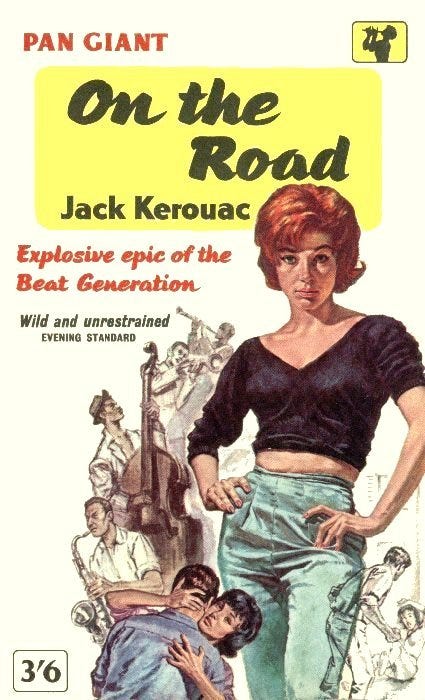
“And this was really the way that my whole road experience began, and the things that were to come are too fantastic not to tell.”
–Jack Kerouac, On the Road
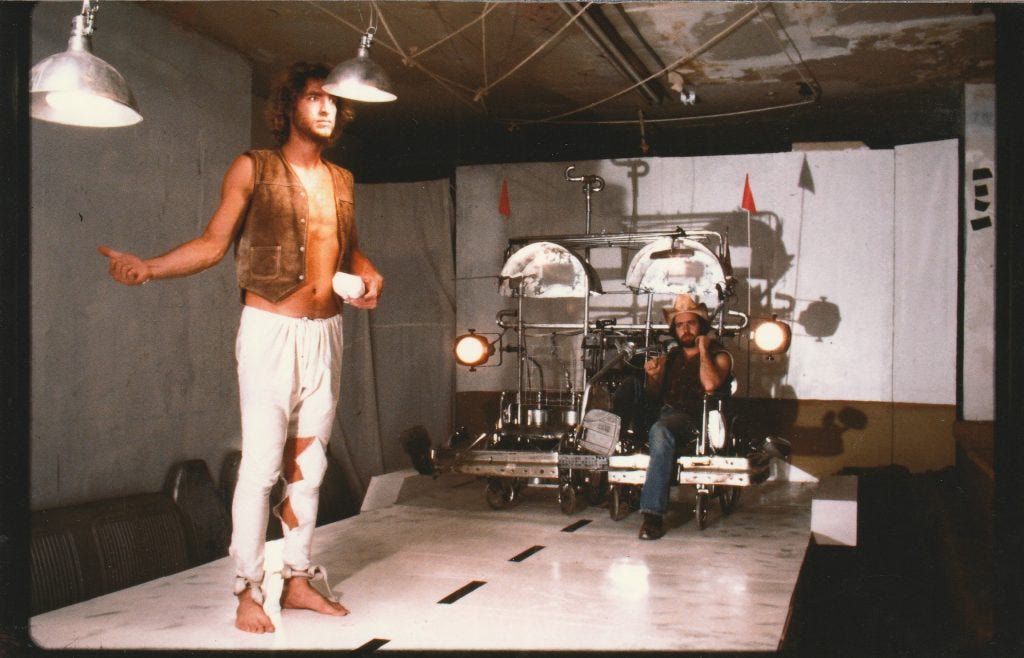
In 1982, in an art exchange with Randolph Street Gallery in Chicago, ABC NO RIO brought Thieves Theatre to their Rivington Street squat on the Lower East Side. At the time we were doing my play Travelling Light. It tells the story of a long-haul trucker, whose CB radio handle is Bird of Prayer. He picks up a strange hitchhiker carrying a dozen eggs. The entire performance takes place within the Vehicle of Knowledge. Bird of Prayer and Easter Bunny travel toward a rendezvous with a seductive female voice coming over the CB radio whose handle is Mountain Belle.
At a city auction, we bought a Chicago Police paddy wagon, loaded in the Vehicle of Knowledge, and drove to New York City. We slept at NO RIO the six weeks we were there, showering at the nearby Allen Street Public Bath; it must have been the last one left in the city. We paid a local graffiti artist to paint the paddy wagon with a Thieves Theatre logo so it wouldn’t get tagged by others. Pulling car seats from all the stolen and stripped vehicles under the Williamsburg Bridge, we created seating for the audience at No Rio.
Travelling Light is my only play but I instigated a redux version of sorts sometime in the late 1990’s, beginning with an On the Road collaborative writing project with David Bucci and Lisa D’Amour. Bucci bought a van with the money he received from Woolly Mammoth theatre company, which commissioned a play from him. He toured out of Austin to the Northeast with his rock band. Lisa left Portland in her Eagle headed toward Minneapolis and New York. Bucci sent postcards, Lisa sent audiotapes, to the Dean Street archive.
I drove the humongous RatMobile around the country with the conceit that I would pick up one and all hitchhiking playwrights headed to the July, 1999 Los Angeles Rat Conference. I drove from Philadelphia to Nashville to Dallas to Memphis to Vegas to Los Angeles.
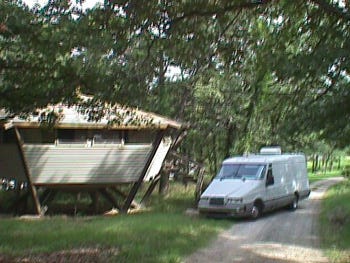
Josh Furst took a Greyhound out of NYC to catch the RatMobile in Memphis. Our dispatches to the ManWithVan.com website needed an internet connection. We found that in the Petro Stopping Centers. The RatMobile did not quite belong in the TRUCKS ONLY parking section, but the 18-wheeler truckers adopted the ugly duckling as one of their own. Along with the daily dispatches about our “kicks on Route 66” and Josh’s bus trip memoir Irish Jew Riding the Slow Dog, we also posted a realaudio rant and 10-minute plays from five playwright hitchhikers.
Road Rants and Rambles by Lisa D’Amour
Flamingo Chili by Werner Trieschmann
Bolt’s Dream by Robert Harders
Crossing by Paul Mullin
It’s Good Enough for Me by Barry Rowell
I can’t remember the exact time sequence on all these writing/performing collaborations, but it was a years-long relationship. Many of these road warriors had once made the rendezvous at the New York RatFest(ation). That ten-day writing/performance frenzy was across four different theatre venues– HERE, Ohio Theatre, New York Theatre Workshop, and Coney Island USA.
The most memorable event for me was the dozen different site-specific writing/performance acts in the Coney Island USA museum. In one act, Bucci on guitar accompanied Lisa’s song to the dead eye of a Steeplechase horse.
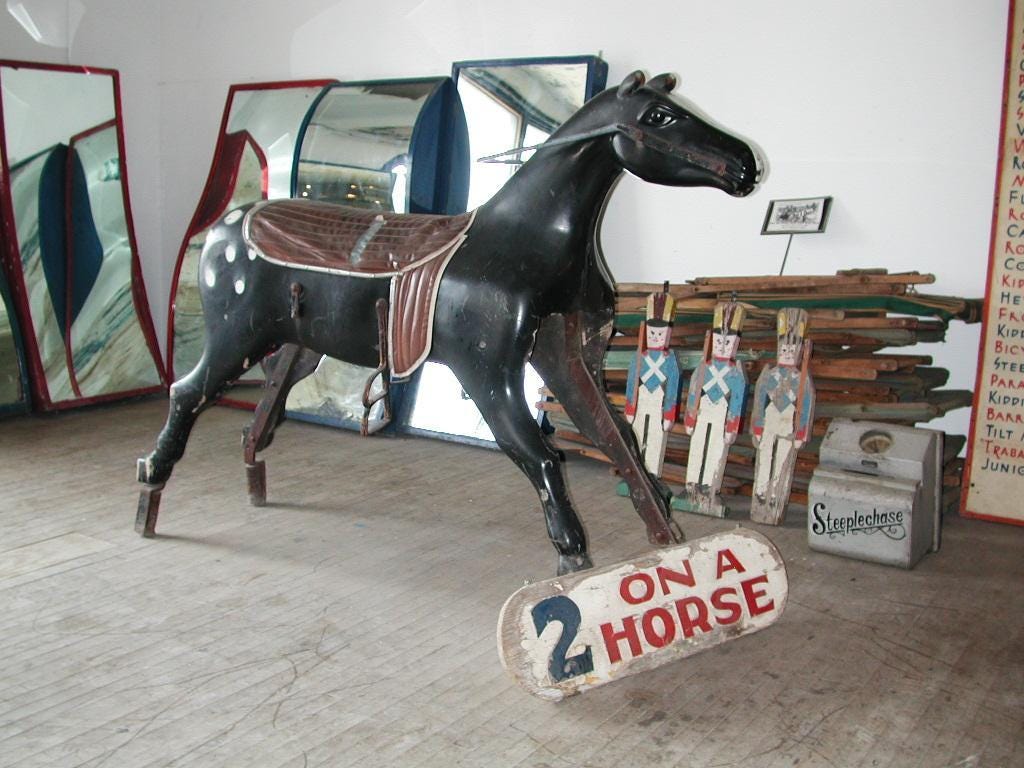
In the closing scenes Bucci was tied to a wooden chair. Our friend, Jennifer Miller, the bearded lady, was performing in the concurrent sideshow running downstairs. She was scheduled to come upstairs between her acts. She’d perform a striptease for Bucci while she recited some Camille Paglia text. She’d then take a straight razor to Bucci’s seven-year-old sideburns. She missed her cue, so it was left to Lisa to take the razor to the majestic sideburns. The night ended with the audience lining up to pour red wine over Naked Elvis in the bathtub.
Having a bearded lady neutering the sideburns, instead of Bucci’s musical duet partner Lisa, would have added a different layer to the deed, but not necessarily more potent. Most in the room knew Lisa and David as fellow playwrights heavily involved in the Austin theatre scene, so seeing Bucci bound and squirming to free himself, and Lisa cockily approaching with a straight razor created some true drama. Maybe that Austin theatre scene was more cutthroat than we all imagined.
In remembering this act, I feel as if I should find some metaphor or allegory in those sideburns that Bucci had been maintaining for seven years. Something about the value of writing versus the value of a life lived.
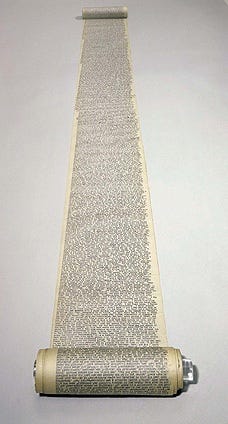
When Jack Kerouac died, his estate was reportedly worth only $100. The original manuscript of On the Road was typed in 21 days on a 120-foot scroll. In 2001 the scroll was sold for $2.43 million, the highest price anyone had ever paid for literature at auction. This year it was put up for auction again. The winning bid was $12,135,000.
In the period from 1951, when the scroll was written, to 1957, when it was finally published as a book, Kerouac argued with various editors to have the work published without fictional names. He even went as far as attempting to get signed releases from all the major “characters” in the work.
Many readers and critics have classified On the Road as an autobiographical novel, which places it within autofiction. The scroll, however, uses the real names of people — Jack Kerouac, Neal Cassady, Allen Ginsberg, William S. Burroughs and others — which makes the work closer to a memoir, a chronicle of the cross-country road trips with his writer friends.
There is a journey, where a life lived is also a life written. Where readers are closer to witnesses and fellow travelers on the same road trip. Where writing is not just a chronicle, but also an enactment, a ritual that sanctifies life and experience. The body and its memories are required on the page as much as they are in life. And sometimes you have to sacrifice some sideburns to make it all real.
The essays here in Meta-memoir are written contemporaneously with the weekly episodes in Tipi on the Hill. This essay is concurrent with the episode Mickey D.
These essays are also an examination of the rubric itself: Meta-memoir. Please engage in the comment section in any of these essays about the nature of your own creative nonfiction.