I. The Revelation
Only after writing the previous essay Nick & Steve & Nick & Steve did my cousin email me the birth records she had copied on a visit to our grandparents’ small town of Asiago, Italy.
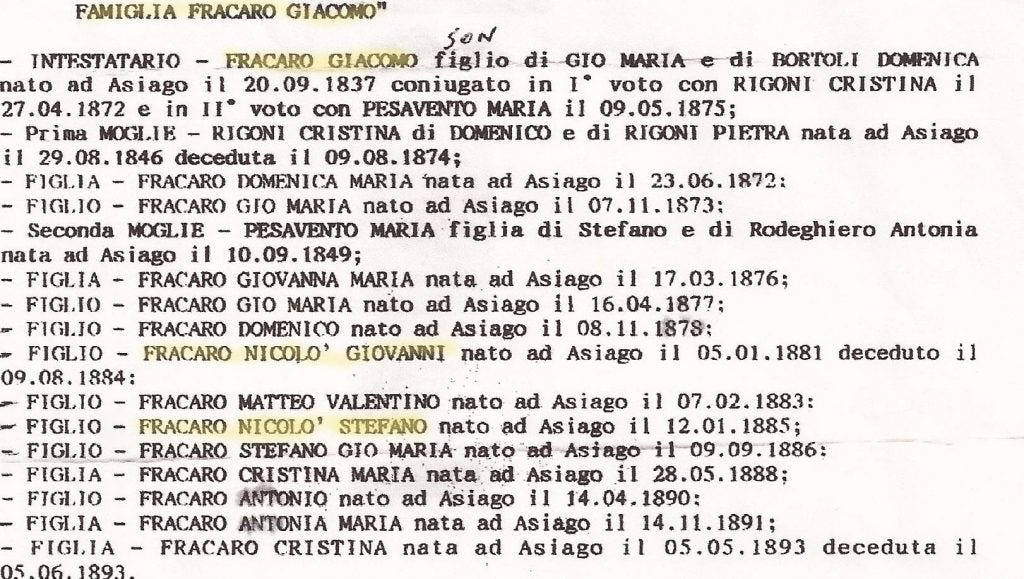
My grandfather’s birth name was Nicolo Stefano Fracaro.
He had changed his middle name to James after emigrating to America — James, or Giacomo, being his own father’s name. But the original name carried everything:
Nicholas Fracaro — born 1885, Asiago, Italy. Died 1925, Lockport, Illinois. Car accident.
Stephen Fracaro — born 1924, Lockport. Died 1971, Lockport. Car accident.
Stephen Fracaro — born 1954, Lockport. Died 1978, Lockport. Car accident.
Nicholas Fracaro — born 1952, Lockport...
The hushed voice in the graveyard. The one that spoke to his youngest son Stephen, and to his grandsons Nick and Steve, as we crossed Calvary Cemetery on our way to the Popoviches. The one that was speaking to me as I wrote the previous essay, before I even knew what it was writing.
Nomen est omen. Name is destiny.
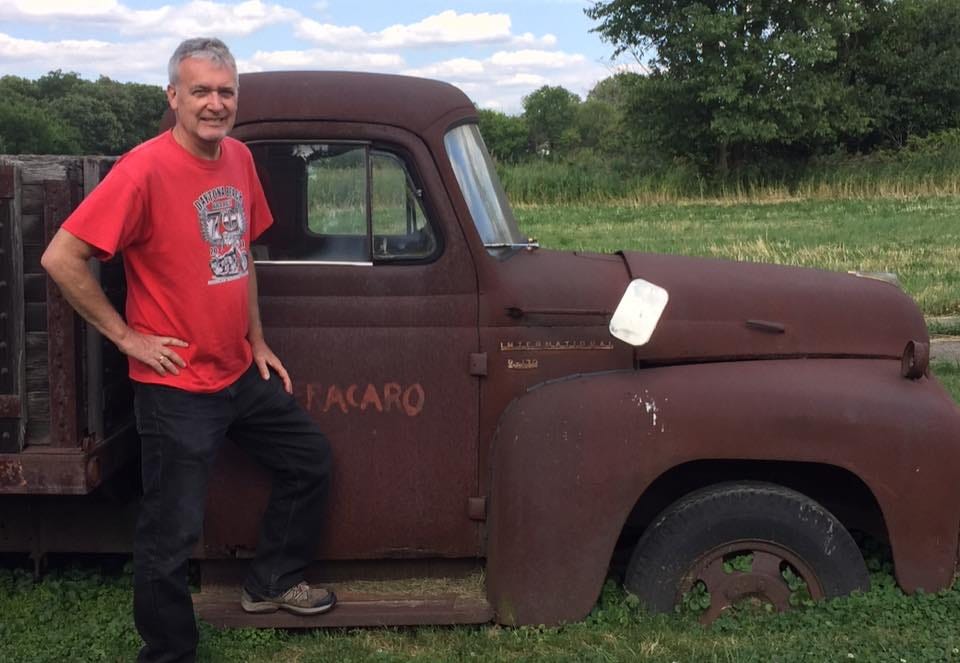
I have owned dozens of automobiles over my life. As I got older and bought newer models, the odds that any given car would outlive me increased. But the hushed voice was coaching me toward a different scenario. The last car and I would die together. The same end story as Nick and Steve — and Stevie before me.
I understand people who buy vintage cars. A vintage car captures a unique time and memory the way a photograph does — but unlike a photograph, you can take a ride in it. A three-dimensional memory.
The first real car I bought was a Buick Electra 225 — the Deuce n’ a Quarter. Real because it was already legendary, and the memories it carried were already becoming legend. Memories that you summon and retell over and over are no longer memories. They transform with each telling. They become something more than the true story. They become the legend you live by.

II. Cops and Robbers
Having grown out of playing Cowboys and Indians, we began playing a new game. Cops and Robbers.
Some of our early delinquency was actual crime. Most of it was rowdiness — public fist fights, disorderly behavior, just a general ‘fuck you,’ asserting our existence against a world that preferred we be quiet. The local cops became the authority figures absent from our family lives. Not quite parents. A few became almost like older brothers.
The earliest memory of cops intervening in our play happened at the supermarket in a small strip mall. The mall, like the bowling alley next to it, was our playground in the summer when school was out.
Pennies from Heaven. One of us would climb the wall in the back of the supermarket up to the roof. The others grouped in the parking lot below, positioned where we could see customers coming and going but they couldn’t see us. We could spend an easy hour watching people try to figure out how pennies were materializing around them. An added benefit: this improvised outdoor theatre allowed for underage smoking.
We could have entertained ourselves all summer. Then someone added water balloons.
The first balloon that hit the sidewalk near a customer ended the game. He brought the manager out to investigate. The manager found the makeshift ladder we’d built from wooden skids on the back wall. The jig was up.
Armed now with water balloons, we sought more elusive and dangerous prey — meaning any given adult. We resented their unearned authority, their smug compliance to boring everyday life. We positioned ourselves on a hilltop along the country road, hidden in tall weeds, and waited for approaching cars. The four of us threw simultaneously. A direct hit meant the windshield. The driver always stopped for a direct hit — sometimes got out of the car — which sent us running for the nearby woods. Only once did an angry driver chase us, his fury apparently cooling somewhere in the field before the trees.
We added rocks to the arsenal — though only against tractor trailers on the two-lane highway, always at night, always from behind gravestones in the cemetery across from the bowling alley. The rocks hit the trailers in loud booming echoes. We watched from the edge of the graveyard as the driver climbed out of the cab to inspect the damage.
Mission accomplished.
Then came the fire.
A two-acre lot of undeveloped land sat about a hundred yards from the mall. Midsummer, the weeds were waist-high and bone dry. We went to the center, started a small fire, and walked back toward the mall squirting lighter fluid in the weeds behind us. By the time we arrived, the fire had found the fuel. The lot was engulfed. Smoke stopped traffic on the highway in both directions. Five minutes later: firetrucks, squad cars, the fire out, traffic moving. Everything back to boring normal.
Except for the squad car that rolled into the parking lot and pulled up to the four of us.
Tully. A friend and hunting partner of my older cousin. He had once shown Steve and me the deer he’d killed in his garage — more than his legal tag allowed — the kind of minor lawbreaking that passed as ordinary life in that world.
“You’re George’s cousin, aren’t you? Fracaro, right?”
The conversation was brief and expertly conducted on both sides. Tully asked what we knew about the fire. We knew nothing. We were sure about that. He let the word arson fall between us like a stone. Then: “Alright guys. Don’t do anything stupid.”
He drove away.
To celebrate our first encounter with the police, and escaping scot-free after committing “arson,” Bob opened the fresh pack of cigarettes we had bought just prior to setting the fire. We usually shared a single cigarette, each taking a couple drags at a time, passing it back and forth between us. But for this momentous occasion, Bob gave each of us our own.
III. The Inherited Poison
In the 1960’s, if there were regulations restricting the sale of cigarettes to minors, they were not enforced. Kids were routinely sent to the store to buy cigarettes for their parents, and no questions were asked. We bought ours from the liquor store in the shopping mall, but usually through the vending machine at the bowling alley. A pack cost 30 cents. There were two payphones, one at each end of the building. When we needed money, we disabled the coin return on the phones by stuffing a wadded-up paper ball up its shaft. Phone calls cost a dime. It didn’t take long before we had the 30 cents we needed. We never left the coin return permanently blocked so our trick remained an undetected source of income.
I started smoking when I was eleven or twelve.
I am uncertain about the exact age but certain about the occasion — I retrieved the memory through hypnosis. Guided by the even voice on an audio tape, I imagined a warm beach, the sound of waves, and then: You will now remember your first cigarette.
I had stolen a Kent from my mother’s pack. I walked the southwest perimeter of the golf course across the road to the Rocks — an isolated two-acre tract of large stone formations where my brother, cousin, and I staged our weekly BB-gun wars. I sat back against a stone and took my first puff.
Smoking is not an easy habit to acquire. The first experience is almost always terrible. I suspect that’s why the hypnosis tape had you revisit the precise time and place — to make the original aversion viscerally present again. It worked. Though I’ll say this: of all the dependencies I’ve had — alcohol, drugs, nicotine — nicotine is by far the hardest. When friends saw I’d quit and asked how, I half-jokingly recommended the tape. It works for me every time.
Both my parents smoked Kent — the most popular filtered cigarette of the era. The brand launched in 1952, the same year a Reader’s Digest series warned smokers about emerging cancer studies. Most cigarettes were filter-less when Kent hawked its “famous Micronite filter.” Although advertised as “so safe, so effective it has been selected to help filter the air in hospital operating rooms” and used “to purify the air in atomic energy plants of microscopic impurities,” it was later discovered that the filter contained a particularly virulent form of asbestos — crocidolite, the most hazardous of the six types, causing respiratory cancers at rates far exceeding any other form. Lorillard quietly replaced the filter in 1957, after 13 billion had been sold. They have been litigating cases ever since.
My parents had already inhaled the years that mattered. I introduced my brother Steve and cousin Marty to the stolen Kents at the Rocks. We started visiting the Rocks more to smoke than to wage BB-gun wars.
We needed a peer group to cement the habit. Brother Steve and I found ours in the short walk up the country road to the bowling alley. Finding Nick and Bob Popovich, smoking became a central ritual in our lives — one that needed, to work its full magic, an audience of adults.
IV. The Theatre of Perpetual Adolescence
Nick and Bob called their mother by her first name. Rules she tried to impose were answered with “Sure, Sophie.” We smoked without restriction in their basement. But the ritual needed the public sphere.
Through diligent practice, we all became proficient at The Nose — a facial mask accomplished by widening your nostrils and exaggerating your smile in imitation of Alfred E. Neuman, MAD Magazine’s mascot. We deployed The Nose whenever adults tried to exert authority. Rather than argue, we turned to each other, held The Nose, and stared back until our tormentor walked away in frustration.

The fashion then was for men of a certain age to wear fedoras when they went out to socialize. They left them on the coat rack shelves at the bowling alley before their games. We each stole one — costume for the theatre ritual we performed on Saturdays outside the supermarket. Four thirteen-year-olds, each in an oversized fedora, each holding a large cigar, positioned a few yards from the entrance. Customers entering and exiting were greeted by four Alfred E. Neuman lookalikes, cigar smoke curling upward.
MAD’s editor Al Feldstein had been precise in his instructions to illustrator Norman Mingo: “I want him to be loveable and have an intelligence behind his eyes. But I want him to have this devil-may-care attitude — someone who can maintain a sense of humor while the world is collapsing around him.”
Activist Tom Hayden said his radical journey began with MAD Magazine.
Mine — in writing and performance — is the struggle to reinvent the legendary delinquencies and the mindset of the younger self. One matures in craft, but finding the unique genius in one’s life and art is all about preserving perpetual adolescence: the continual questioning of identity and the status quo.
The fedora. The cigar. The Nose. The four of us outside the supermarket, performing for an audience that hadn’t asked for us.
It was already theatre.